

Introducing Chevalier Baltazar
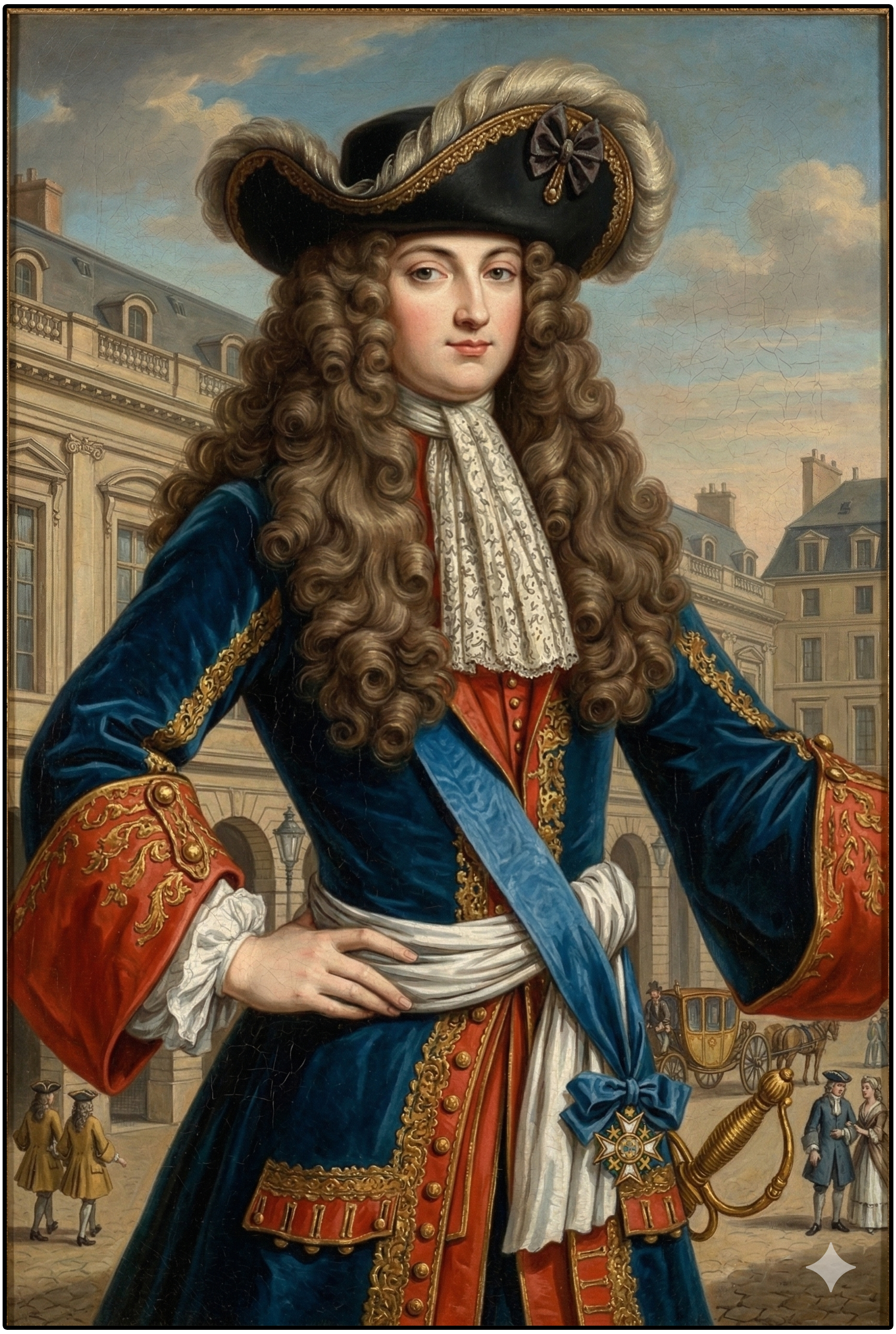
Chevalier Baltazar
AI portrait from etchings
In writing La Maupin, Mistress of the Sword, I’ve added new characters and events into la Maupin’s story, some historical and some entirely my own creation. One of the most dramatic historical characters that I’ve incorprated is Geneviève Prémoy, known as “Chevalier Baltazar”, a figure nearly as exceptional as La Maupin herself.
Like many women throughout history, Prémoy disguised herself as a man and became a soldier. What makes her unique is that she continued to serve after she was found out and was recognized and decorated by the King for her valor. I think that we can safely say that at the turn of the seventeenth century, Maupin and Baltazar were the most famous cross-dressing women in Paris. That alone is reason to introduce her into the story, but there is more.
Here is how and why she came to be a character in my novel…
Who was Chevalier Baltazar?
Stories about a cross-dressing woman soldier called “Chevalier Baltazar” or some variant spelling appeared between 1684 and 1703, each giving her a different name. Only the last seems to be substantiated by official records.
The first incarnation appears in the October 1684 Mercure Galant and is known only as “du Chevalier” and is identified as the daughter of Sieur Vandester. The following month, it is revealed that the military adventures that the so-called “Dutch Lady” attributed to herself were actually those of “Chevalier Balthasar”, for whom no real name is given. The supposed “Chevalier”, Mlle. Vandester, is revealed to be one Marie-Magdeleine La Fosse, an orphan and fraudster.
The next version of Chevalier Baltazar is the heroine of a 1695 novel “L’Héroïne travestie ou les Mémoires de la vie de Mademoiselle Delfosses ou le Chevalier Baltazard”, which some attribute to Eustache Le Noble. Interestingly, the author has given the chevalier a name that is a variant of that of the earlier fraudster: Magdeleine Delfosses. Additionally, the novel’s Baltazard meets a disreputable adventuress who also goes by the name “Chevalier Baltasard.”
The final version is the heroine of another biography, “Histoire de la dragone, contenant les actions militaires et les aventures de Geneviève Prémoy, sous le nom de Chevalier Balthazar”. Prémoy appears to be the true Chevalier Baltazar, and is tied to two different official records, although it is clear that her memoirs have been fictionalized.
How do we know?
The records tying Geneviève Prémoy and her story to the real world are the notice of her funeral and a police report. The funeral notice we have thanks to the work of a genealogist, Charles Guiblet de Boisbissey, who was working about two decades after her death. In his collected extracts from Parisian parish records, we find the following record from Saint-Sulpice, Paris for October 26, 1704: “buried: Geneviève Premoya, called the Chevalier Baltazard, honored with the rank of Commander of the Order of Saint Louis, and formerly Captain in the Regiment of Turbilly; wife of Jean Gouvier, called du Pont, Lieutenant in the same company, who died on the 25th.” (See Chevalier Baltazar in History.)
This record clearly establishes both the existence and the name of Chevalier Baltazar as well as the fact that she was known for having been inducted into the military order of Saint-Louis as a commander. It also ties her to an official police report concerning her biography.
In the Notes of René D’Argenson, the second Lieutenant Général of the Paris police, we find the record of “acts of violence committed by a man of letters” on 30 April 1702. A publisher and seller of books had complained to him about the actions of a man she had hired to turn the memoirs of a woman into an historical novella to be entitled “La Fille Capitaine”. The memoirs in question were those of “a woman so well known in Paris for the blue ribbon she wears as a sash, and for the extraordinary clothes in which she appears”.
Commanders in the Order of Saint-Louis wear the order’s badge on a sash, whereas lesser members pin the badge to their uniform directly. To our knowledge, only one woman captain wore the sash of the Order of Saint-Louis: Geneviève Prémoy. A year after the La Fille Capitaine complaint, Prémoy’s biography was published. We can thus tie both La Fille Capitaine and Histoire de la dragone to the woman who died in 1704, and the scandals mentioned in D’Argenson’s report. (See the La Fille Capitaine scandal.)
What else have we been told?
There are a number of stories told about Baltazar’s life and heroics, largely based upon the fictionalized biography, Histoire de la dragone; for instance, that she was able to pass for a man as long as she did because the surgeon-major who treated her wounds for the first decade or more agreed to keep her secret, but when he died, his replacement did not. At that point, we are told that the reason that she was allowed to continue to serve was that she and her men had saved the life of the King. This makes sense in that it helps explain why she was inducted into the military order of Saint Louis and given the sash and rank of commander within the order.
Though we cannot be sure which of her many purported heroic acts are real, we can be confident that some were. Perhaps one of the more trustworthy claims is the novel’s report that she was born March 15, 1660, in Guise, Picardy. While de Mailly likely embroidered her adventures to make the book more exciting, he has very little reason to fabricate her birthdate. She is the more likely source for that information.
In 1866, Alfred Tranchant summarized Baltazar’s life story, based upon Histoire de la dragone. You can find that summary on the Chevalier Baltazar from Alfred Tranchant page.
What did she look like?
We have two primary sources for Chevalier Baltazar’s appearance: an illustration by Jacobus Harrewijn that was published in the Histoire de la dragone, and one created and published by Nicolas Arnoult and sold by him in his shop on rue de la Fromagerie, Les Halles. Because Arnoult was selling the pictures stand-alone, they include a short biography. Here's what he had to say:
Here is the portrait of the Captain of Carabiniers, who was presented to the King in October 1692 dressed as a woman and who, in fact, was recognized as such due to a wound she received in her breast. She had been serving the King in his armies for eighteen to twenty years. His Majesty granted her a brevet as a Knight of the Military Order of Saint Louis, of which she wears the Cross, along with an annual pension of nine hundred livres. She was known by the name Chevalier Baltazard, and now, by order of the King, she wears a skirt, but she also wears a justaucorps, along with a hat, a wig, and a sword at her side.
I had the Gemini AI create a composite based on these two etchings. The results were a bit more idealized than the originals, narrowing her face and making her look a bit less robust and younger. Then, based upon the uniform colors of her regiment, I had it produce a pseudo-watercolor version. All four can be seen below. An “oil painting” variant appears at the top of this page. It served as one of the reference images I used for imagining her as I wrote my novel.
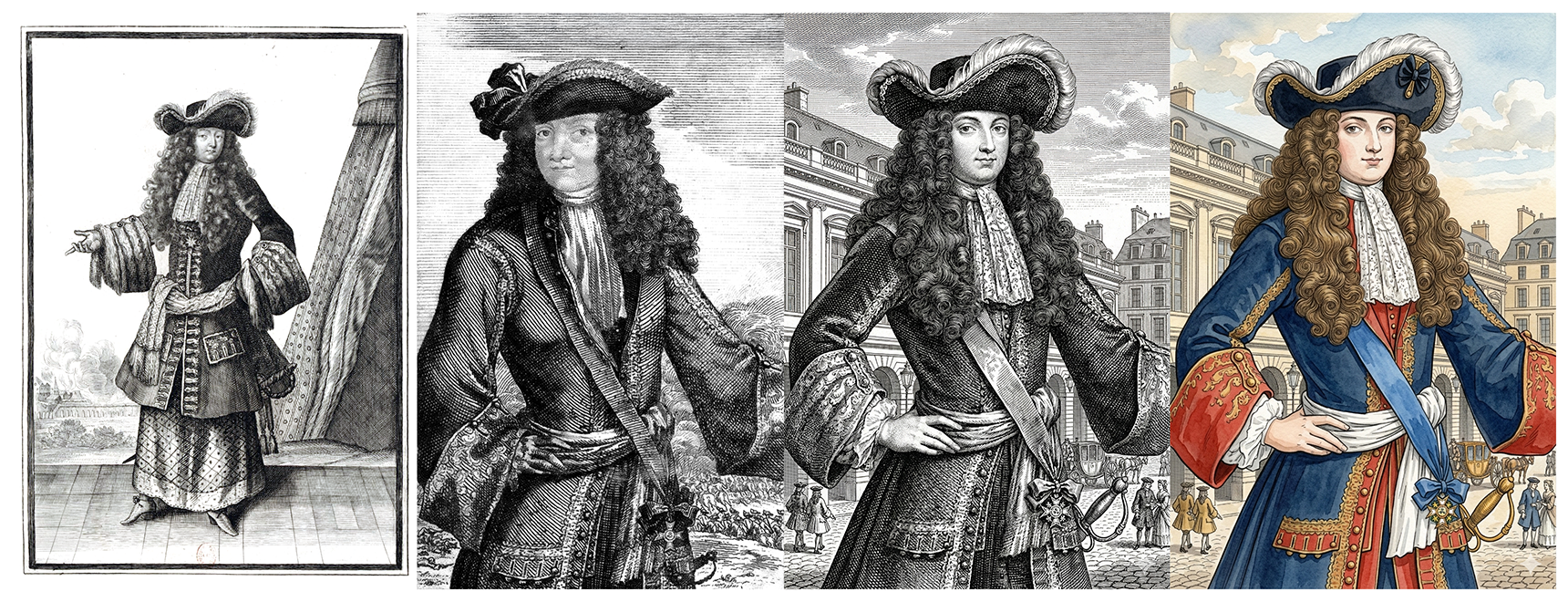
Etching by Nicolas Arnoult | Etching by Jacobus Harrewijn | AI image by Gemini based on them | AI watercolor version
The original version of this page was devoted largely to just the two etchings, and includes larger versions of them, as well as both transcriptions and translations of their captions.
As ever, if you’d like to be notified when there are more behind-the-scenes pages like this, or snippets from the novel, you can join my La Maupin mailing list by clicking on this link to send me email, with a subject line mentioning “La Maupin feedback”.