

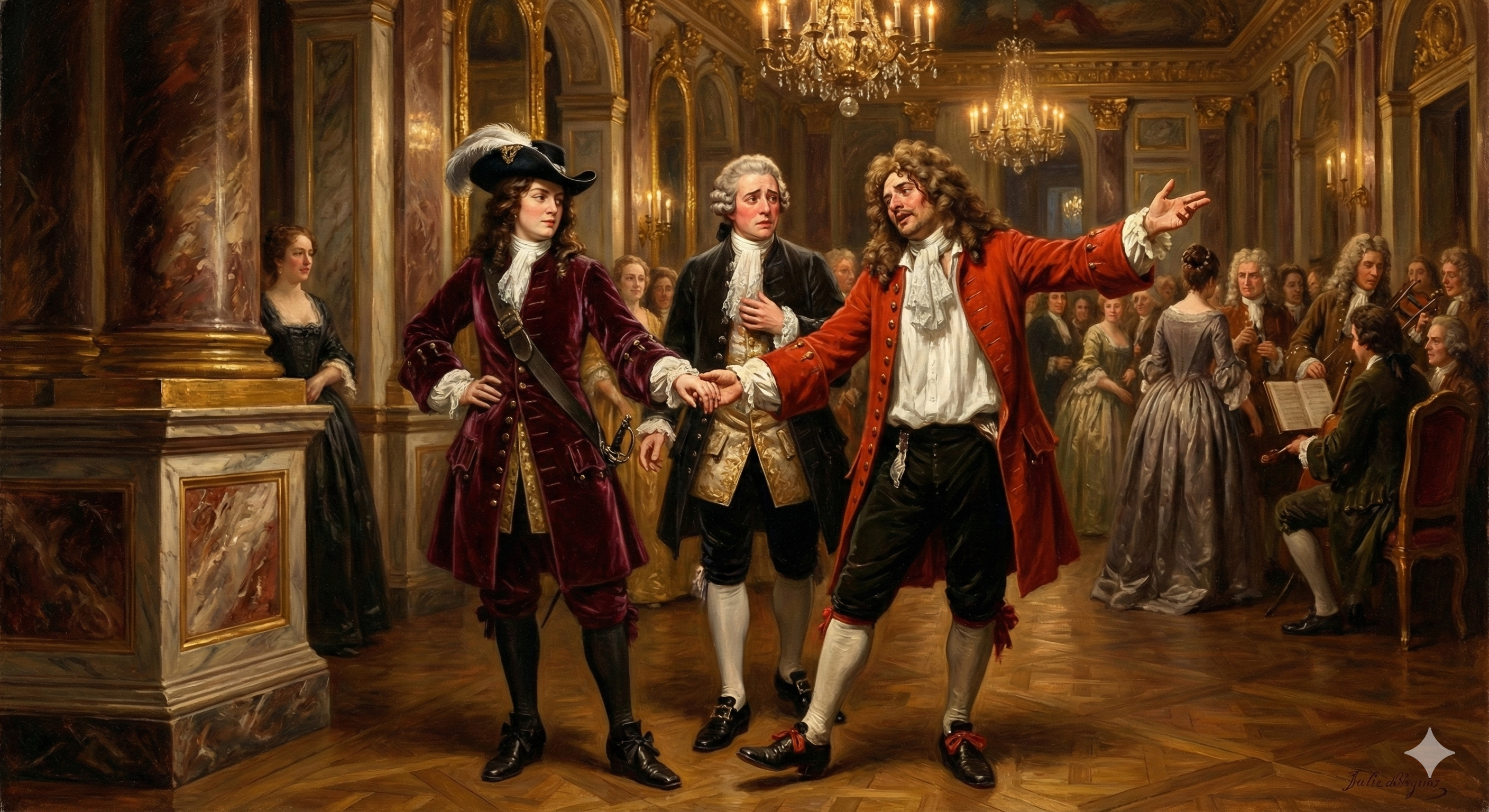
La Maupin is introduced to Thévenard’s friend, Chevalier Bouillon. Illustrated by Gemini AI.
Snippet: Enter Bouillon…
The following is taken from “Chapter 20: Reprise” of the current working draft of La Maupin, Mistress of the Sword. The setting is Paris, in the season of 1698–1699. As our scene opens, Julie and d’Albert are taking a rather tense carriage ride back from an evening at Procopio Cutò’s café. He has been forced to explain a certain exchange that had occurred during the evening—exactly what, we will leave for another time. For now, it will suffice that it has not set well with Maupin.
“We may not have been very discreet.”
“You, comte d’Albert, indiscreet! Impossible!”
“Émilie… This is not going well, I’m afraid.”
“I believe you are right.”
Just then, the carriage came to a halt. Someone knocked upon its door. D’Albert opened it, revealing Bernard, with Jacques standing behind him. The carriage was in the inner court of M. Langlois’ hôtel.
“Will madame be alighting here?” asked Bernard.
“Or are there things that I should fetch from your rooms, madame?” asked Jacques.
“I believe I shall be staying here,” replied Julie.
Bernard offered her his hand as she stepped down. “Thank you, Bernard. Good evening, comte,” she said, and strode into the building, followed by Jacques.
He accompanied her through the common room and up the grand stair, hurried ahead and opened the door to her suite.
“Will there be anything that you require, madame?”
Julie looked in, and seeing Marie-Claire, replied, “No, thank you, Jacques. That will be all. Fetch me breakfast for one in the morning, something substantial. The ice cream was excellent, but I shall be hungry come morning.”
“But of course, madame.”
“Better yet, make it breakfast for two. I will pen a note to Mlle. Elise for Thurin to deliver first thing tomorrow. Fetch me a pot of chocolate and a bottle of ratafia—cerise, perhaps—from Marion’s, and whatever is best of the day from the pâtissier and the fruit-seller.”
“Very well, madame. Shall I send the boy up for the note this evening or first thing in the morning?”
“Tell him to come up in the morning.”
“Yes, madame.” And with a short bow, he departed.
❦ ❦ ❦
The next morning, Elise Pérignon was, indeed, pleased to receive Julie’s romantic overtures, as was the beautiful young Jeanne-Marie a few days later. Thévenard was a bit surprised by the attentions that Julie paid him for the first time since their brief liaison in Rouen. D’Albert, of course, was not left out entirely, but it became clear that there were others, both men and women, sharing Julie’s life, love and bed. She even managed to reconcile with Countess de Mauvesin of the quartier Saint-Déshonoré.
D’Albert strove to remedy the situation, but the revelation of ██ █████ seemed to have opened a permanent rift between them. They remained intimates, but some part of her was walled off, and periodically anger simmered near the surface. He did what he could, but it was not in his nature to wait for a change, and so, after a few weeks, he, too, began to take other lovers.
Professionally, it was a triumphant time for her. She felt obliged to be worthy of her doubled stipend, and threw herself into her work, bringing each rôle on the stage as alive as the many personas she took in life. Both the audiences and the Académie responded to the new passion of her performances. Her voice had always been beautiful, but now it came alive with emotion.
Late in April, as Julie entered the foyer of l’Opéra after the premiere of Thétys et Pélée, she spotted d’Albert flirting with Madame de Luxembourg at the other end of the room. Incredible! Their liaison had been rumored for weeks, but to flaunt his affair with the wife of Charles, the duke of Luxembourg, prince of Aigremont and Tingry, etc., etc. in public? He must be mad!
A moment later, she spotted Thévenard in the company of a rakishly handsome and clearly inebriated young gentleman. Devil take d’Albert! She turned to join Thévenard.
“Gabriel,” she cooed as she took his arm, “who is your handsome friend?”
Thévenard, still not used to public displays of affection, stumbled over his tongue for a moment. “Pardon me. Monsieur Bouillon, may I present La Maupin, Mlle. Julie d’Aubigné. Julie, ma chère, this is Frédéric-Jules de La Tour, Chevalier Bouillon.”
Julie ran an appraising eye over Bouillon. His clothes were rich and stylish—the finest wool, silk and linen—but worn with such a studied negligence as to border on the slovenly, especially in light of his obvious inebriation.
“Enchanted, mademoiselle,” he said, and reached out.
She laid her hand in his, and he bowed over it as if to to kiss it, his free hand making a sweeping gesture that caused those standing nearby to back quickly out of the way.
“A pleasure to meet you,” Julie replied. She squeezed his hand and pulled him towards her. Leaning closer, between the two men, she continued. “Now, you two just must tell me what mischief you have been up to.”
“We were discussing,” Bouillon confided, “women and wine and where to find them.”
Thévenard blushed, as many eyes were drawn their way.
“Truth be told,” she responded, “I am quite fond of both. Shall we three go in search?”
With that, she linked arms with both men and swept them out into the Alley of the Opéra and the Paris nightlife beyond, looking back only enough to see that d’Albert had observed their departure. It had been very hard to miss. Their arrival into the alley was noticed by Jacques, who followed them at a discrete distance. His employer was dressed “en chevalière”, wearing a sword, and seemed to be in control of the situation, but the lackey was not one to take unnecessary risks.
The trio made their way to the gardens of the Palais-Royal and then into the arcades surrounding it, stopping at a few of the taverns and cabarets they held, where Jacques lost track of them. By the time he found them, Bouillon and Julie were arm in arm, with Thévenard following in their wake—all having had considerable to drink.
“Though…,” Bouillon confided to Julie. “…no suitable woman–”
“…no willing, wealthy, widowed woman…” she interjected.
“–no suitable woman has been found,” he continued. “It does occur to me that one woman has been present throughout our journey—one of considerable beauty and charm.”
“Indeed? Not suitable, but beautiful and charming?”
“Well, perhaps not suitable as a wife–”
“–not for a bloody prince… ah, prince of the blood, a destitute, hopeful, bloody prince.”
“Well, one must have aspirations. But that is not my present focus.”
“It did seem to be–”
This time it was he who interrupted. “For a time that was my hope. But now it is my realization of the treasure at hand.”
“A treasure, now. A beauteous and charming treasure?”
“A veritable treasure you are. And right beneath my nose, the entire time. A considerable oversight, one well worth correcting.”
They staggered through a gateway out onto Rue de Richelieu.
“I see,” she said. “And where is it that this insight, this overturned oversight is leading us?”
“Well, perhaps to your abode or mine?”
“As it so happens, sir, that street up there,” she replied, pointing up Rue de Richelieu. “…is, in fact, the one where I reside. The one upon which my residence opens. At the very least, it might be suitable that you walk me home. Thévenard—” She waved a hand back behind them without looking. “—I am sure, can find his own way home.”
“Comte d’Holstimplon can be most resourceful.”
“Holst-where?”
“My mother disapproves of my associating with commoners of the Opéra–”
“Another way in which your charming treasure is not suitable….”
“A minor consideration. She would have disapproved of the quest for wine and women no matter who the comrades were. In any event, I have therefore elevated him to the noble title of comte of Holstimplon a place full of Walloon or German buffoons or some such. It has not endeared him to her, but….”
“From washing dishes to foreign nobility? He has risen.”
When they were close to M. Langlois’ hôtel, Jacques passed them by, carrying Julie’s hat. He slipped in through the servant entrance, grabbed the large key to the main gate, and opened it wide just as they arrived.
“Thank you, Jacques,” she said as they entered. “Breakfast for two in the morning… with coffee—lots of coffee. Bread with honey, fruit if you can find it, and… coffee.”
“Coffee, Madame?”
“From the apothecary of Maître Lefèvre…. Not too early, please.”
“But, of course.”
And so it came to be that Chevalier Bouillon entered Julie’s regular coterie of lovers. They were becoming numerous enough that he somewhat displaced his friend Thévenard, as would become a bit more apparent with time.