

When is AI Art Appropriate?
While I’m determined to have the cover for La Maupin, Mistress of the Sword and the full-page illustrations for the Deluxe Edition be art commissioned from human artists, there’s at least one illustration that I would like to include in the book that is created using AI. I value the opinions of my readers, so I’d like your (click on this button or any similar button on the page to send me email) on the question: “When is AI Art Approriate?“The Context
Because the story of the novel is a combination of real history, La Maupin’s legend and my own imagination, the book includes an extensive Afterword, revealing what’s history, tradition or fiction. Along with this, I think I’d like to have a second section of backmatter: contemporaneous pictures of the major characters. Because many of them were prominent or famous people, the celebrity culture of the day produced prints and etchings featuring them. There are a couple for la Maupin herself, as well as Mme. de Florensac, Geneviève Prémoy, Chevalier Bouillon, and so on, all done at the heights of their fame or notoriety.
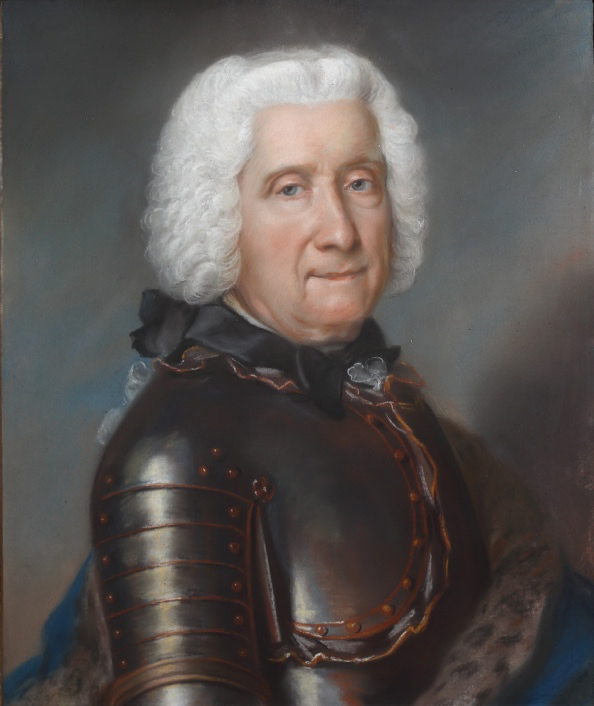
Prince Grimberghen aka Comte d'Albert, age 60
But one important character is missing: Comte d’Albert, Maupin’s long-standing lover. The only image that I can find of him is from when he was about 60 years old—30 years after La Maupin’s death. In addition, where the others mentioned appeared in books and prints sold by street vendors, d’Albert, known then as Prince Grimberghen, comes to us as a full-color painted portrait. This is problematic not only because it doesn’t match the others, but including it in the print edition means printing the book in color. (There is a second painting of him, this time as a young man alongside his younger brother, but I cannot find a good scan or photo of it. If you know where I can find it, drop me an email ✉️.)
The Images
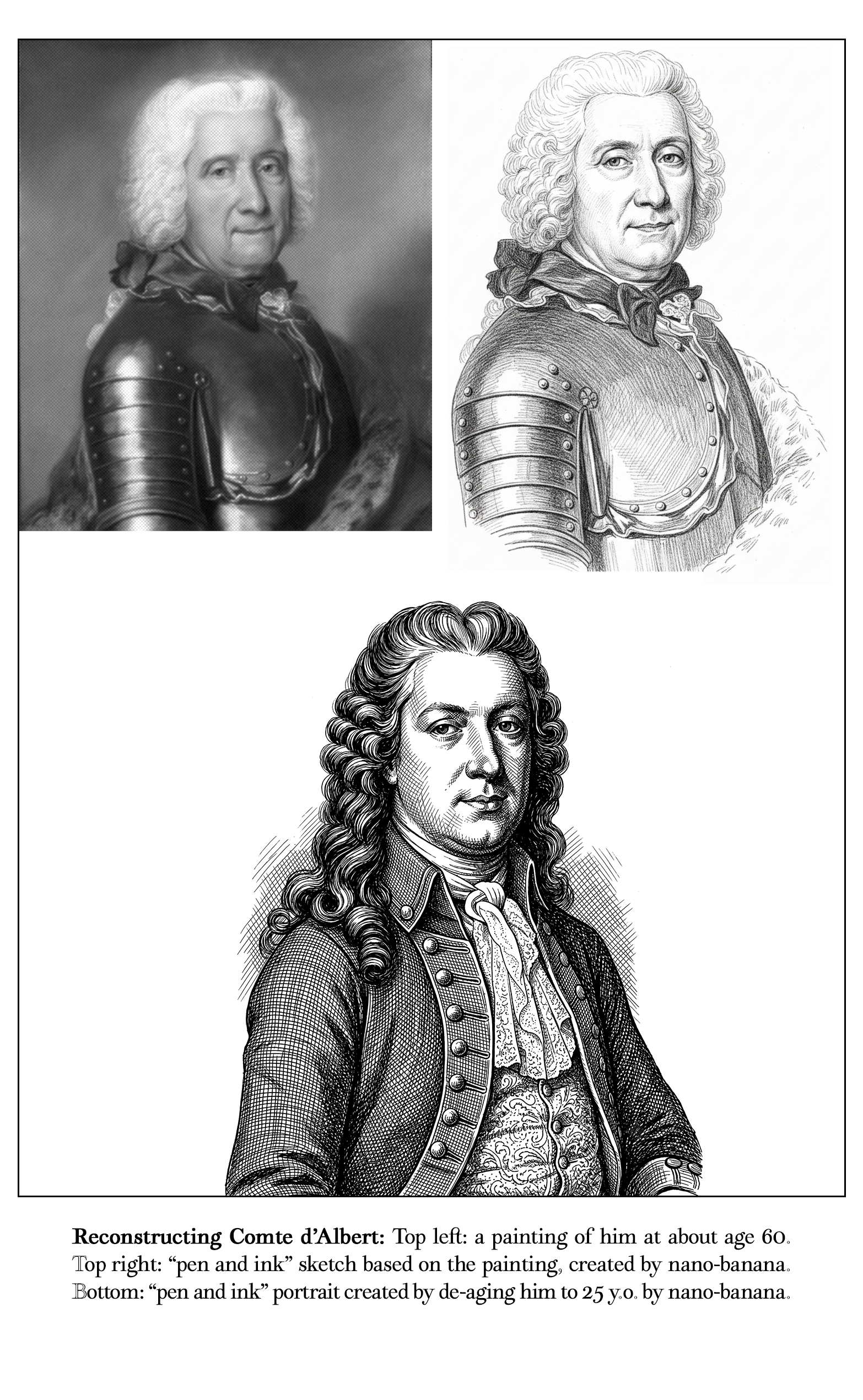
If I want to include d’Albert, one of the most significant men in La Maupin’s life, in the “What did they look like” historical gallery, at the very least, I am going to have to turn the color image of a painting into a black and white illustration for the print edition of the book. I’ve done that using Photoshop: converted the Grimberghen portrait into grayscale, tuned the contrast of the background, head and torso sections, scaled the image, and done a halftone screen. The result is a usable image of what he looked like 30 years after our heroine last saw him, done in a totally different style and medium than the rest of the images in the gallery. It can be seen in the upper left of the page image to the right.
Having accomplisted that, I tried a different tack. I took the image of the painting to a couple of the better generative AI engines and had them create a pen-and-ink style black-and-white version of it. Google Gemini’s “nano-banana” produced a tolerable image in a style that, while different than the others in the gallery, was at least similar. It can be seen in the upper right of the page image above.
But it is still of a man—the 60-year-old Prince—that Maupin never saw, so I took the process one step further: I asked it to de-age the figure from 60 to 25 years old and dress him in the uniform of the regiment that he commanded. Both of these manipulations took multiple iterations to assure that the AI fully “understood” the assignment and created the desired image. It can be seen at the bottom of the page image.
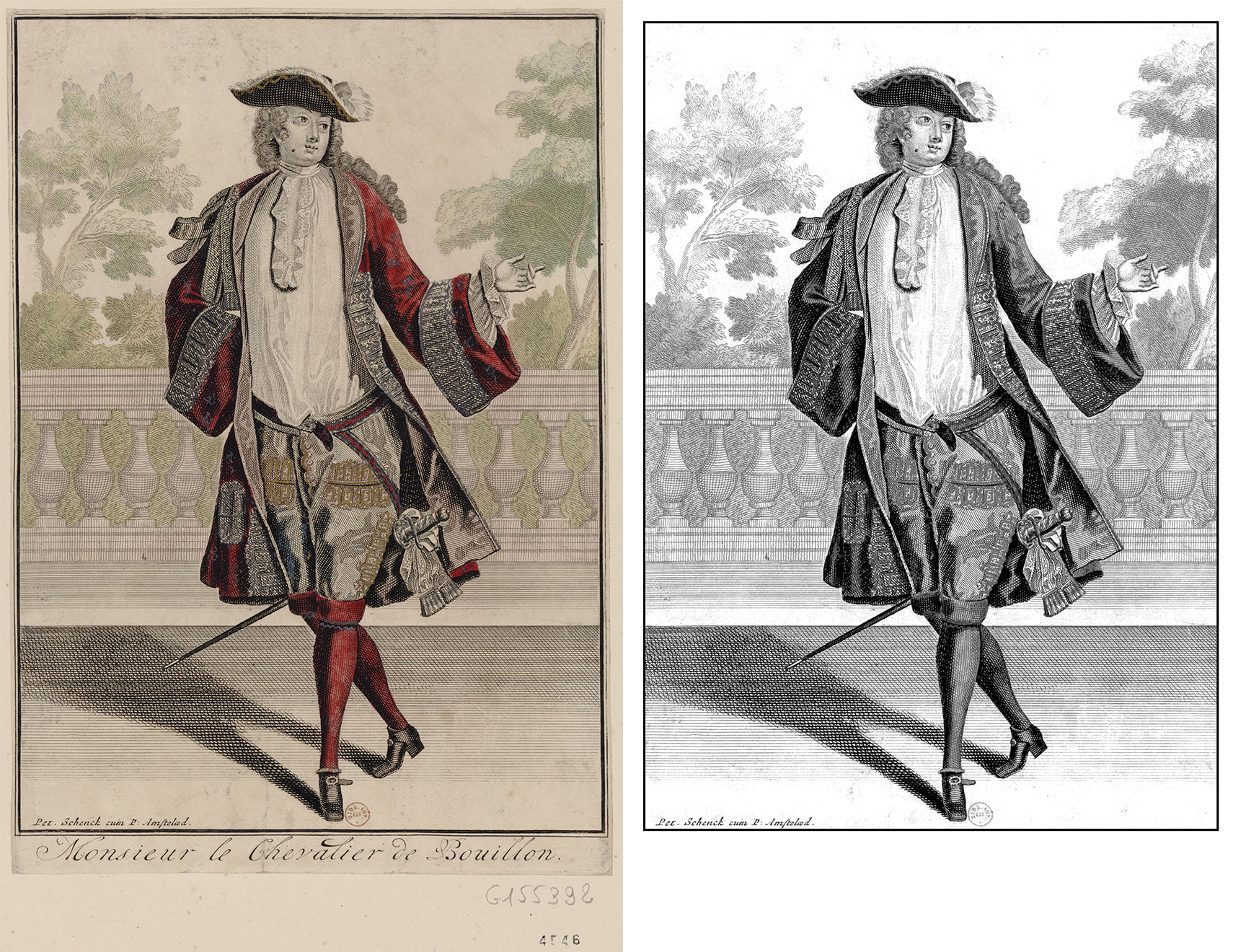
Chevalier Bouillon
All three of these images take a good deal of processing to create. Even the halftone version of the original painting makes use of a bit of generative AI to get just right, though very little. And none of this work is crucial enough that I would pay an artist, especially one who specializes in all of the forensic, biological and historical expertise to properly de-age the painting into a pen-and-ink drawing of the younger man. Realistically, given my budget, no one is losing income if I include the AI image in my collection of public domain historical portraits.
On the other hand, having an image of comte d’Albert as a handsome young officer to compare with Maupin’s other paramour, the black-sheep Chevalier Bouillon, is valuable to me and my readers. The image here, to the right, was taken from an aged hand-colored print and required both a good deal of photoshop expertise and AI to extract as a clean line-drawing. While the two images are not comparable in style, they do have their origins within the lifetimes of the men in question, and can give a feel for the differences between them, and help explain why I portrayed them as I did in the novel, and how my vision of them is based upon how some of their contemporaries saw them.
The Questions
The main question is: “When, if ever, is it appropriate to use AI art in a book such as La Maupin, Mistress of the Sword?” There are more questions, both broader and narrower:
- Is AI art ever appropriate?
- When, in general, is it appropriate?
- Is it appropriate on the cover?
- Is it appropriate in the interior?
- Is it appropriate on this website?
- Is it appropriate behind the scenes?
I’ve been studying Machine Ethics for more than a decade because, since the early 2010s, it has become obvious that machines are acting more and more like people, and that’s likely to continue. As it does, we’d better make sure that they act like good people not bad, and that AI, like any important technology, does more good than harm. As a result of my studies, I am convinced that there are appropriate and inappropriate, even dangerous, uses for AI, so question #1 for me is a “Yes”, and question #2—”When?”—becomes crucial. The rest of the questions help clarify “when”.
On the cover: Having published two books already and dressed about 180 comic book covers, I’ve developed a pretty strong answer regarding cover art. Cover art represents the work to the world. Putting an AI cover on something you sell means that you’re using a machine rather than paying an artist (or doing it as an artist yourself). I really can’t justify that. More than that, the cover art becomes the face that you are presenting to the world. If the cover, the face, of the work is artificial, then that suggests that the work itself is.
While dressing commissioned art for all those comic book covers, I found that it is sometimes useful to use AI in small ways, ways that are nearly imperceptible. At times, the commissioned art doesn’t quite fit the dimensions of the cover, or the trade dress obscures the art rather than harmonizing with it. When that happens, as a graphic designer or editor, you rework the art a bit: fill in a little detail around the margins, cut out one piece so that it can be placed in front of the title, logo, etc., while the rest is behind it. Much of that, I did by hand. Some of it was AI generated. As an editing tool, after the artist is compensated, I think AI is appropriate to use, so long as it doesn’t detract from the art. I doubt anyone, even the original artists, can tell which covers I did using AI and where I used it.
What do you think?
Within the book: With the cover having set expectations as to what is within, it seems to me that, in general, the interior art operates under the same constraints. If you’re selling it, and the choice is between having it produced by a human or a machine, then you should do it yourself or commission work from a human artist. In the past, my frontispieces, maps, and comic book interiors have all been done by human artists, again, possibly with a bit of largely imperceptible editing.
In La Maupin, I want to add interior illustrations in two forms: full-page illustration “plates” at the beginnings and ends of chapters, and in the back material, a series of historical images depicting the characters as they were shown back in the day. For the main illustrations, I am in discussions with a couple of artists as part of a project to produce an illustrated edition. (See here for details on the project.)
Original Chevalier Bouillon hand-colored artwork
But what of the gallery of characters? For all but one, I am using images created about 300 years ago, not commissioning new art. There’s one character that I don’t have an appropriate image for, so I want to produce one based on roughly 300-year-old art, but heavily processed, using AI. The question is, who is hurt by this? If I don’t use AI, I will probably just leave the character out. Commissioning a contemporary artist to portray the character doesn’t match the other artwork in this section. To me, it seems like no living artist is being hurt by my using AI to edit an historical piece.
Moreover, in order to ready some of the other historical art for publication, I’ve done quite a bit of editing to remove color or damage etc. This case is different only in how much AI I am using. Every pixel in this illustration will be created by AI. In the others, the original art is still present, if enhanced. See the original art, to the right, upon which the earlier Chevalier Bouillon image was based. It was significantly edited in order to be printed in black and white.
What do you think?
On the website: For the most part, my answers to the previous questions have been fairly straightforward for me. This is the one that, so far, has given me the most pause. I try to minimize my reliance on AI art, but at the same time, it fills a very real need. There are definite tradeoffs, and I try to keep any AI usage “appropriate”—I just don’t always know what that means.
I can’t afford either the time or the money to commission artwork for each page I add to my website, so AI art makes a good alternative to having plain pages, and I’m not displacing any human artists by using AI, but just like the book cover, the website introduces people to the book, and a reliance on AI art can give the same wrong impression. How can I strike the right balance?
Perhaps the most important single piece of artwork on the site is the logo that is used on the front page and in the banner of all subsequent pages. Because of that, I created it myself. I have a little art training and come from an artistic family, so I spent simply ages creating the logo. Using a half-dozen or so reference images, I sketched by hand and then reworked in Photoshop the silhouette of a woman in men’s clothes lunging with a sword. (For the nerds in the audience, I created it as a path in Photoshop using hand-crafted Bézier curves and then turned it into a shape.) I then combined it with the title of the book written in a font styled after 17th-century French court hands.
What do you think?
Behind the scenes: Beyond all of that, there are images that I have AI generate with no real intention to share them with the world except, perhaps, in discussions like this. There are quite a lot of them. One of the most common examples of this is one I mentioned above at the outset: creating character portraits. I do this for lots of characters, both real and ones that I make up. I do this in order to picture the characters themselves or scenes that they appear in. I’ve written about this in my postings about La Rousse Ressuscitée and the snippet introducing Chevalier Bouillon.
Another example is much more detailed, and represents a couple of days’ worth of work on my part. I had a couple of scenes in mind and a prop that ties them together, and I wanted to see whether it was plausible and how it might work out. I also wanted a real understanding of what the prop—a painting—might look like so that, if necessary, I could describe it in detail.
The scenes center on the creation and eventual fate of an intimate portrait of La Maupin and Mme de Florensac, specifically an allegorical or mythologically themed, somewhat risqué, intimate portrait, given by one to the other.
I started out by opening a chat with Gemini regarding allegorical and mythological portraits in the last few decades of the 1600s and the first decade of the 1700s. I did it as a chat with Google’s AI rather than a series of searches because I knew I’d want to revise the idea as we went along. Google is blending search and AI a lot these days, so either way you need to verify the results. This time I was brainstorming, so I started in chat.
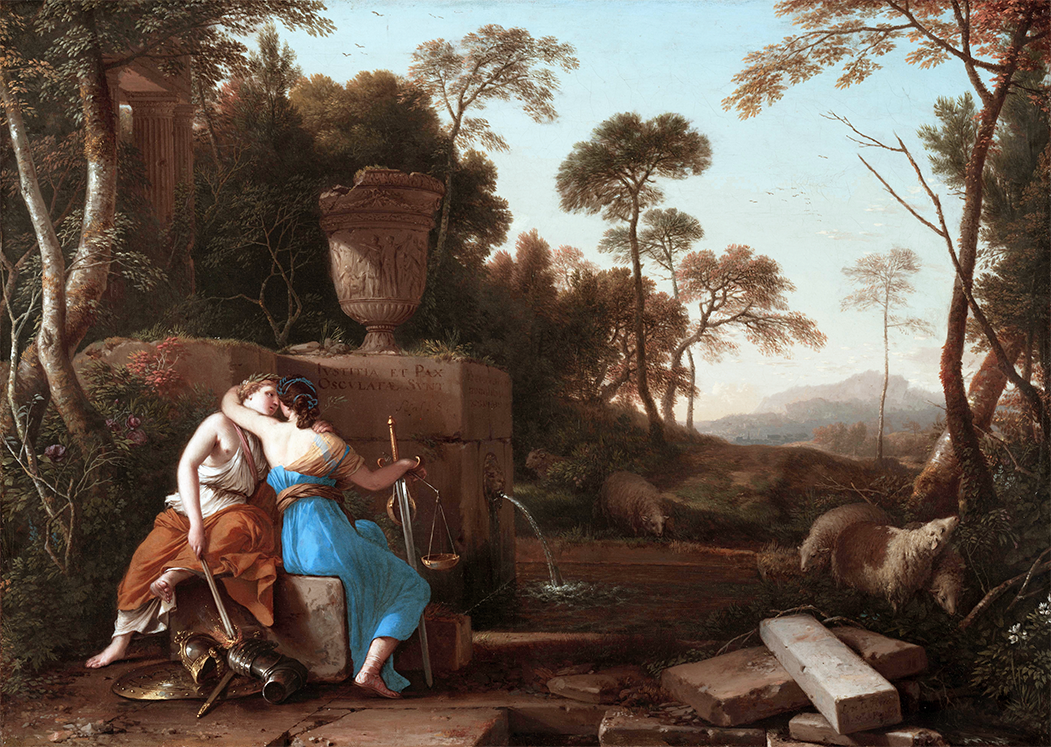
The actual de La Hyre painting
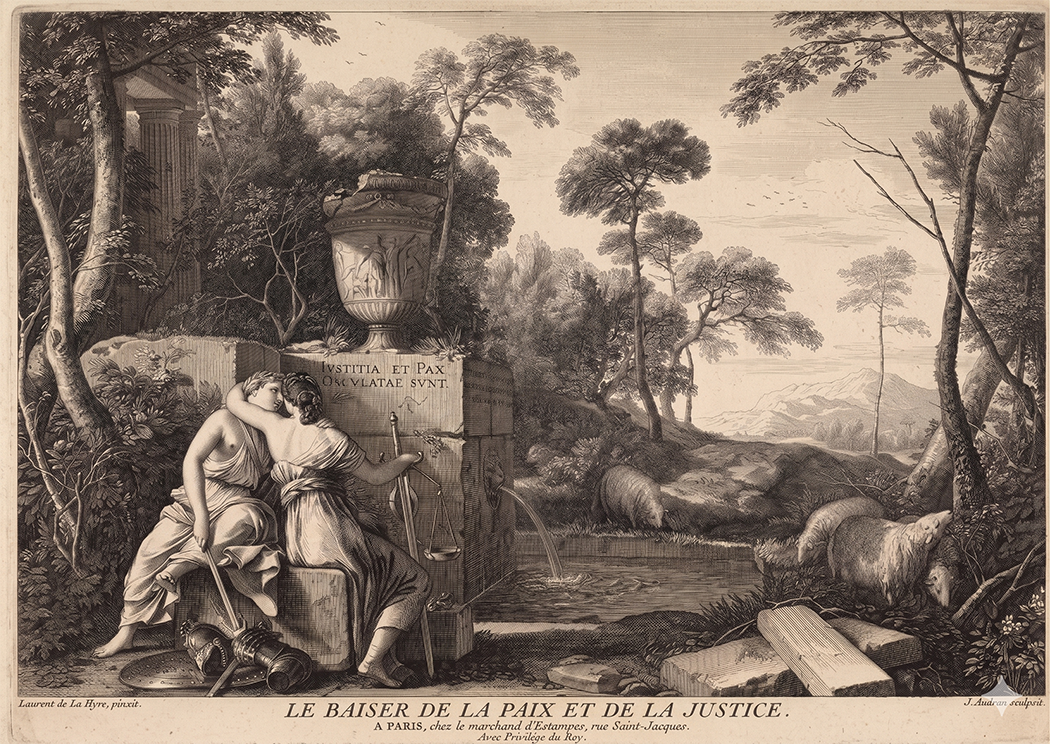
AI-generated hypothetical etching
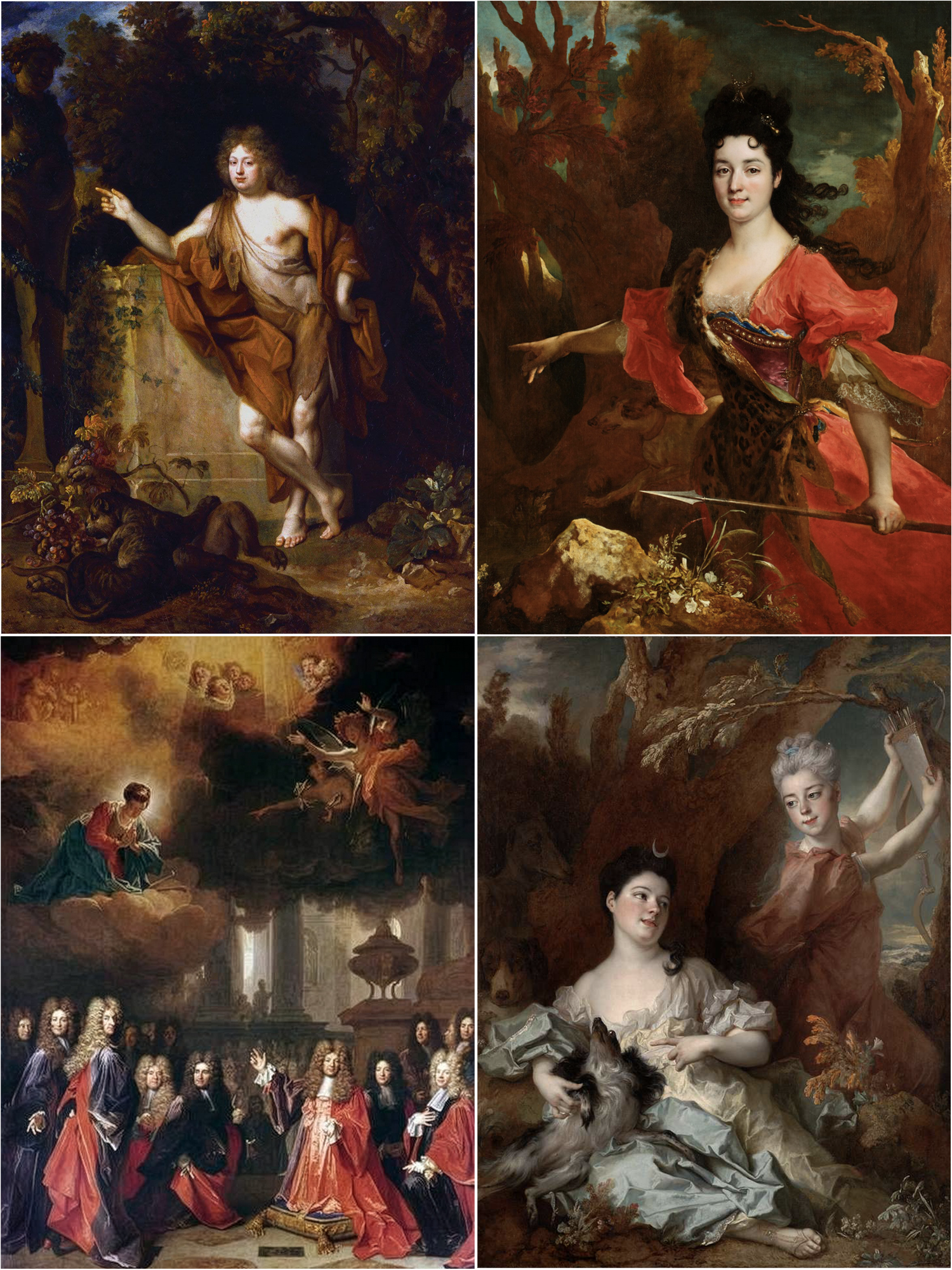
Actual allegorical portraits by Largillière
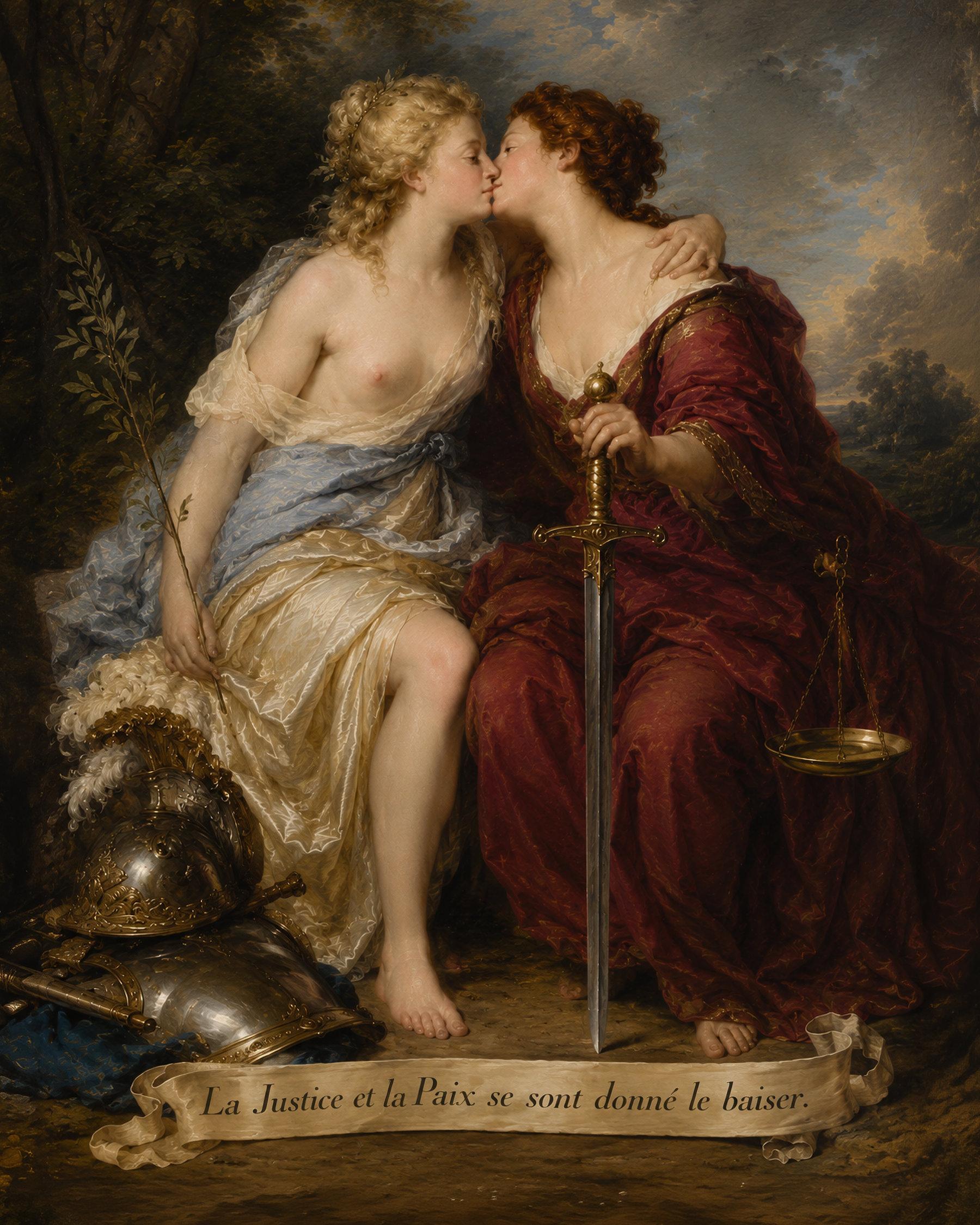
AI-generated hypothetical painting
The idea looked pretty plausible. Both mythological and especially allegorical portraits were relatively common at the time of my story, so I started looking at allegories involving two women. One painting caught my eye: a dark-haired woman embracing a blond woman, with a hint of eroticism: “The Kiss of Peace and Justice” by Laurent de La Hyre, based upon a line from the 85th Psalm, using Greco-Roman manifestations—Justitia and Pax.
The 1654 painting was relatively famous, and etchings based on it were relatively popular 50 years later. Unfortunately, though there are a number of such etchings in various museums and archives, they were hard to find online. I therefore had Gemini create a mock-up of such an etching. It was the sort of thing that either La Maupin or Mme. de Florensac might have a copy of.
That led me to ask for a plausible fictional name of an artist that they might have commissioned a portrait from. Gemini suggested that instead, I use a real artist, one who did about 1,500 portraits during his career, several of them allegorical: Nicolas de Largillière. I looked into several galleries of his work and found that, yes, he did do allegorical paintings, but while some of them featured half-naked men costumed as classical figures, none of the portraits of women were quite as risqué as the de La Hyre—no partial nudity. On the other hand, the works were largely portraits commissioned by the subject or a family member, and few of them were as transgressive as Maupin and Florensac.
My next step was to have both Gemini and ChatGPT create an image based upon the style of Largillière, casting Maupin and Florensac as Justitia and Pax, along the lines of the de La Hyre. Given that the nudity was somewhat risqué, both AIs felt that the kiss should be rather chaste, lips barely touching, if at all. We added the quote from the Psalm in a banner. Gemini asked what Bible the quote should be from. I thought the Sacy, more or less France’s equivalent of the King James, would be best. Gemini liked that. It would make the allegory and Bible reference clear to anyone who saw it, not just those who could read Latin.
As we got to the point of creating the image, Gemini wrote a little passage in which Largillière pushed back and wanted to use the scholarly Latin from the Vulgate. Both AIs are frequently offering to write scenes and dialog for me, even though I don’t ask for it and never use what they offer except for the very occasional turn of phrase that jumps out at me. I do, however, take a certain amount of advice from them when they point out wording or idioms that appear anachronistic. ChatGPT also favored the Latin.
None of this is something I would pay a human to do, and I don’t intend to include any of the generated images in anything that I charge money for, and they weren’t created to be used here on the site. I’m posting them only to explain this usage in enough detail to ask the question, “Is this sort of behind the scenes usage appropriate?”
What do you think?