

Chevalier Baltazar from Alfred Tranchant
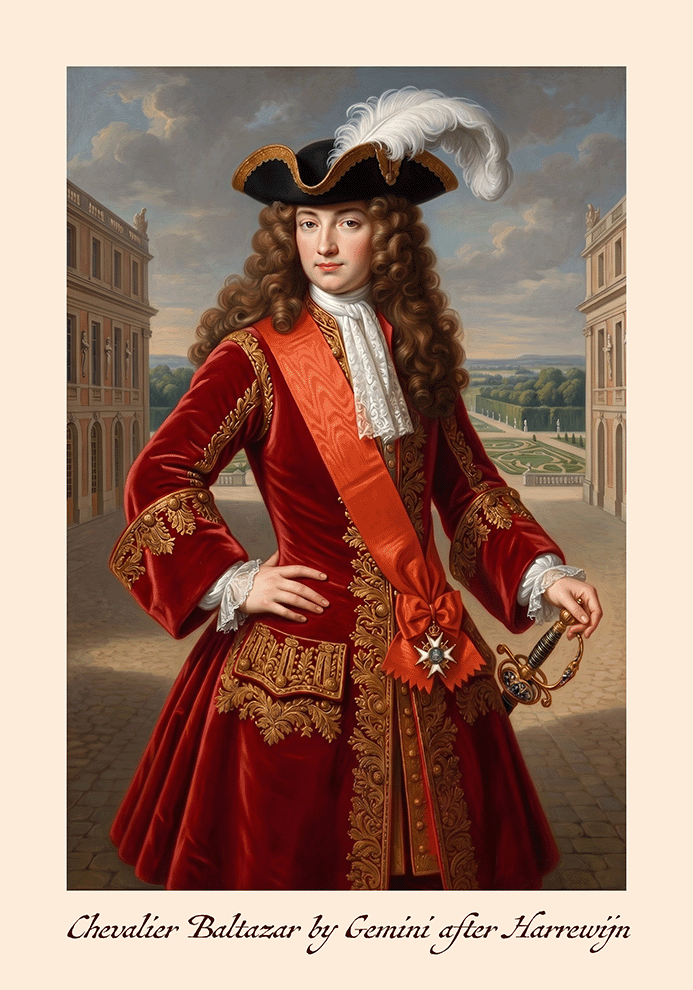
AI image based on the
illustration and description from
“History of the Dragone”
Alfred Tranchant, in his 1866 book Les Femmes Militaires De La France: Depuis Les Temps Les Plus Reculés Jusqu’à Nos Jours, recounts the life of Geneviève Prémoy, the cross-dressing soldier known as “Chevalier Baltazar”. Since he bases it on The History of the Dragone, her autobiography which we know her publisher Mme. Auroy had Chevalier de Mailly fictionalize, his version cannot be taken as entirely factual, but there isn’t a better source for most of her life.
Baltazar may not have done everything he credits her with, nor been injured as many times as claimed, but she did serve for many years and was awarded the Order of St. Louis and honored for her service. The historical facts that we know are covered here.
In my novel, I have used the timeline given here, along with the fact that a year or two after she was awarded the Order of St. Louis, someone, probably Eustache Le Noble, published an fictional biography, Mémoires de la vie de Mademoiselle Delfosses about a female soldier named Madeleine Delfosses who supposedly went by the name Chevalier Baltazard.
That her nom de guerre was used in a novel full of not only martial, but sexual and romantic adventurism did not sit well with our Baltazar. She may have been particularly annoyed by the fact that Delfosses had encounters with another, even more scurrilous, “Chevalier Baltazar”. This led her to writing her own more factual autobiography, one that her publisher, Marguerite Auroy, found drab and boring, and so hired a fantasist to liven it up. I’ll leave that story for another time. For now, here is Tranchant’s retelling of Baltazar’s life.
“Geneviève Prémoy, the Dragone Known as Chevalier Baltazar, 1660–1702”
Geneviève Prémoy was born on March 15, 1660, in Guise, Picardy.
Gifted with an extraordinary taste for all masculine pursuits, by the age of six she was riding shaggy horses at full gallop, handling pistols, and fencing—sword in hand—against trees. Later, she took pleasure in wearing men’s clothing, a whim that soon drew both criticism and the wrath of her brother.
Indeed, after an argument on the matter, her brother struck her in the face. She immediately struck back with the butt of a pistol she happened to be holding, delivering a dangerous wound to his head. Fearing the injury might prove fatal and dreading her mother’s fury, Geneviève decided to leave the family home. She went first to Douai, then to Lille, where she permanently adopted male dress and took the name Chevalier Baltazar.
The new chevalier soon enlisted as a volunteer in a cavalry regiment under the Prince de Condé and was assigned to Captain Barthe’s company. At that time, Flanders was the main theater of war: preparations were underway for the siege of Condé, which the King would take at the opening of the 1676 campaign.
Baltazar was part of a reconnaissance detachment near Ypres. The small group encountered an enemy unit, charged it with vigor, and after a long struggle, forced it to retreat. In this first engagement, the young chevalier—then just sixteen—was seriously wounded, but managed to kill one of the two officers who had fired at her, and captured the other. Upon her return to camp, she was greeted with general acclaim, and Marshal d’Humières praised her publicly before the entire army.
The trenches before Condé were opened April 26, 1676. Barely recovered from her wound, the chevalier took part in every assault, and distinguished herself at the most dangerous posts. Once the city was taken, Bouchain and then Aire were besieged in turn, and in both cases Baltazar gave further proof of her bravery. After being insulted by a German officer from Marshal Schomberg’s staff, she fought a duel with him—disarmed him—and spared his life, though she could easily have taken it.
The following year, during the siege of Valenciennes commanded by the King himself, Baltazar was in a detachment that was ambushed by superior forces. She was lightly wounded by gunfire. Enraged by the injury, she charged the enemy commander, dodged the man’s pistol shot, and fired back with such precision that she struck him dead. Then, returning to assist her comrades, she helped drive off the attackers, who fled in disorder, leaving many of their dead behind.
On March 17, during an attack on a crownwork in that same city, Baltazar was struck by a sword below the left eye—a wound that left a scar she carried for the rest of her life, a visible testament to her courage.
After Valenciennes was taken, the chevalier risked her life to save many civilians from the fury of looting soldiers.
At the siege of Cambrai, which began on March 22, Baltazar, constantly found in the most exposed positions, was knocked down by the shockwave of a cannonball. The blast left her deaf for fifteen days. Not long afterward, at the Battle of Cassel, she narrowly escaped being killed by a pistol shot—but she unhorsed the enemy rider who had fired at her and took him prisoner. Later, during an assault on a supply convoy near Charleroi, her horse was shot from under her. She continued to fight on foot until, inspired by her example, her companions captured the convoy.
At that time, both sides were sending out numerous detachments to patrol the countryside. Marshal d’Humières dispatched a column from Lille, composed of soldiers from the Quincy and Condé regiments, with Baltazar attached to it. This column encountered an enemy troop whose numbers intimidated the French commander. When three of his cavalrymen fell, the officer—seized with panic—abandoned his men and fled back to the city he had come from. There, in an attempt to justify his desertion, he falsely claimed that his entire force had been cut to pieces.
Meanwhile, Baltazar had taken command of her comrades, calling out in a firm voice:
“Courage, gentlemen, follow me! I promise you complete victory. Let us redeem the failure of our officer by proving to our enemies that his example does not deter us from fighting—and from conquering!”
Hardly had she spoken these words when she spurred her horse at full gallop straight toward the enemy commander and struck him dead with a shot from her musketoon. Then, continuing the fight with renewed energy, she was wounded in the thigh, and her horse had its ear shot off. Nevertheless, Baltazar did not stop fighting—except for the time it took to bandage her wound with her handkerchief. She then charged again so forcefully that the enemy was compelled to surrender and follow her into the city of Lille.
Marshal d’Humières, informed of Baltazar’s arrival with the prisoners, came in person to receive them and to give the brave fighters the praise they had earned. He embraced the intrepid chevalier and, taking her by the hand, said:
“We are going to dismiss the commander who had no qualms about abandoning you, and we will promote you from cornet to lieutenant, since it is only right that you take his place—until a better opportunity arises to offer you a rank more worthy of your merit.”
In 1678, Ghent was besieged by 60,000 French troops, while several roving units, one of which included Baltazar, simultaneously blockaded Ypres, Charlemont, and Namur. The regiment in which the chevalier was serving had been detached from Marshal de Luxembourg’s army to join the troops of d’Humières in burning enemy fortifications. There again, Baltazar bravely put herself in harm’s way, coming away this time with only two bruises.
The young cornet soon had another opportunity to distinguish herself, and in a far more remarkable way. She had just been placed in command of a detachment assigned to capture a convoy departing from Mons. The sight of a much larger enemy force caused hesitation among the French soldiers, who began to consider fleeing. But a few forceful words from the chevalier rekindled their fighting spirit. Without delay, Baltazar charged forward, and fought with such ferocity that she routed the enemy escort and seized the cargo. During the battle, the fearless cornet was struck by a musket ball. Though the wound was serious, it did not prevent her from taking part shortly afterward in the Battle of Saint-Denis, where a bullet to the head forced her to undergo the dangerous operation of trepanation.
Following the final conclusion of the Peace of Nijmegen, Baltazar’s regiment was disbanded at Dunkirk, and she was granted the title and pay of lieutenant on half-pay in the Gesvres regiment. Soon after, she was given an active lieutenancy in her old regiment under Condé.
Five years later (1683), war flared again in Flanders. The Holy Roman Emperor and the King of Spain, moved by jealousy toward Louis XIV, reopened hostilities over the borders of the territory ceded to France by the Treaty of Nijmegen. In December, French troops laid siege to Courtrai, and Baltazar was among the besiegers.
In one encounter, the commander of an enemy unit fired two pistol shots at her at near point-blank range but missed. Lieutenant Baltazar, showing superior skill, shot him dead with a single bullet and captured his horse. At that moment, a Spanish cavalryman tried to avenge his leader and fired at the chevalier, wounding only her horse. With a single stroke of her sword, she split the attacker’s skull. Terrified by the death of their commander and the heavy losses, the enemy force fled, aided by the cover of a nearby forest.
Baltazar, at the head of her men, rode triumphantly back into Courtrai on the horse she had seized in battle.
The following year, during the siege of Luxembourg under Marshal de Créqui, now serving as a lieutenant in the Schomberg regiment, she was struck in the neck by a grenade fragment that might have taken her head off—but by extraordinary luck, it merely grazed her, causing a wound more wide than deep.
On October 6, 1688, the siege of Philippsburg began, commanded by the Dauphin, Louis of France. The city capitulated on October 29. Baltazar was hit there by a spent bullet that crushed the button of her buff coat and wounded her badly in the chest. Soon afterward, under the walls of Briscatel Castle in Germany, a German officer shot her in the head with three small pistol bullets. Only two of the bullets could be extracted.
During the War of the Palatinate, Baltazar had several chances to distinguish herself—and, unusually, she came through the campaign without further injury.
At the Battle of Fleurus on July 4, 1690, she noticed an enemy gunner aiming a cannon at the Schomberg regiment. Seizing a musket from one of La Châtre’s grenadiers, the chevalier took aim and shot the gunner dead. Inspired by this bold act, the French soldiers surged forward and seized the battery.
In March of 1691, Baltazar was called to take part in the siege of Mons. On the way, she passed through Landrecies, where her father had been living for several years with the rest of the family and had since died. Her mother was still alive and continued to mourn the absence of her daughter. The chevalier saw her without revealing her identity, for she feared she might be moved by the tears of that worthy woman and tempted to abandon the career she was determined to pursue to the end. After a brief visit, during which she managed to conceal her emotion, she left her family home once again, flying to meet new dangers.
During the siege of Mons, which was commanded by the King himself, Baltazar was seen several times leading a handful of brave soldiers, carrying brushwood to fill the trenches—fully exposed in broad daylight and under constant enemy fire. Louis XIV praised the courage of the lieutenant and her valiant companions, but ordered them not to risk themselves so recklessly again. They obeyed—and to make up for it, they were among the first to storm the town’s outer defenses, swords drawn.
The capture of Mons was soon followed by the bombardment of Liège by Marshal de Boufflers. During the action, Baltazar had two horses killed under her. A few days later, she was part of the forces under the Comte de Coligny, who had gone to observe the army of the Prince of Orange, encamped above Brinon, two leagues from Liège. There, she was wounded near her right breast, and having lost consciousness, she was unable to prevent the surgeon from applying the first bandage—an operation that finally revealed the sex of the valiant lieutenant. Until then, Geneviève Prémoy’s identity had been kept secret by the old chief surgeon who cared for her and whom she had taken into her confidence. But the discreet practitioner had died a few days earlier, exposing himself to enemy fire while rescuing the wounded.
Geneviève was deeply distressed that her secret would now be known to the entire army. She found consolation only when she received assurance that she would be allowed to continue serving under her rank and the name Baltazar. Thanks to her strong constitution, she recovered quickly and was able to fight in the Battle of Leuze (September 18), which concluded the 1691 campaign. There, she served under the command of the Marquis de Torax.
The following year, Geneviève was at the camp at Gibloux, the main rallying point for the French army. As soon as the King arrived, he organized two corps: the larger one to cover the siege of Namur, which was to be carried out by the other.
Louis XIV, informed that Baltazar was present in the camp, had her presented to him and questioned her about some of her campaigns, which he had heard about from the Prince of Monaco. The King, pleased with the heroine’s answers, invited her to come to Versailles after the war and promised to do something for her.
Moved by the gracious welcome she had received from the sovereign, Geneviève threw herself with renewed zeal into the siege of Namur, where she suffered a contusion to the chest. This did not prevent her from appearing just a few days later at the Battle of Steinkerque, where victory once again favored French arms and brought the 1692 campaign to a close. There again, Chevalier Baltazar drew attention with a deed that contributed to the success of the day: after a fierce struggle with a lieutenant colonel, she broke his shoulder with a pistol shot, then seized the bridle of the officer’s horse and forced him to follow her—taking him prisoner.
It was then that Geneviève Prémoy went to Versailles, where His Majesty, keeping his promise, received her with every mark of esteem and goodwill she could have hoped for.
The following year (1693) gave the chevalier a chance to face new dangers, first at the siege of Furnes, then at the Battle of Pont d’Atrésin (29 July), where she served under M. de La Valette. At a moment when the French lines at Autigny were being overwhelmed by the Duke of Württemberg’s forces—three times greater in number—the enemy concentrated its efforts on the position Baltazar had been tasked with defending near the bridge. Seeing her comrades on the verge of being overrun and about to retreat, the chevalier threatened to shoot the first man who stepped back, and at the same time delivered such a rousing address that they all fought with renewed courage and held their ground until the enemy withdrew, as the Duke of Württemberg had been recalled by the Prince of Orange, who was then in grave danger at Pont d’Atrésin.
In this engagement, Baltazar, locked in combat with a senior officer, brought him down at her feet and nearly met death herself. She was shot in the thigh by a musket ball that also killed her horse; and despite this wound, she continued to fight, until a second shot passed through her body. This event halted Geneviève’s exploits for several years and left her in such a state of weakness that, for a long time, she could take no nourishment but breast milk.
The great king, having learned the extreme state to which Geneviève’s devotion to his service had brought her, ordered that she be cared for at his expense and had her entered onto the rolls of the Knights of the Military Order of Saint Louis, which he had just established (April 1693). He then instructed Marshal de Boufflers to deliver the sash of the order to M. de Laubanie, governor of Mons, and at the same time to Chevalier Baltazar, who was convalescing in that city.
Geneviève received from Louis XIV the special privilege of wearing the cross on a sash, in the style of the commanders of the order.
Four years later, recovered from her wounds, she was sent back to active service in the army at the siege of Ath (May 6, 1697), under the command of Marshal Catinat. The place capitulated on June 16 and surrendered the same day. On September 20 , the Congress of Ryswick opened at the Château de Niewbourg; peace was signed that same day with Spain and England, the next day with Holland, and on October 30 with the emperor. This treaty, bringing an end to the War of the Palatinate, largely restored the conditions of the Peace of Nijmegen and also recognized France’s possession of Strasbourg and the imperial cities of Alsace.
In July 1701, Baltazar was honored with a token of the king’s generosity, by order of which M. de Chamillart, Minister of War, presented Geneviève with a considerable sum. A few days later, in August, Louis XIV himself gave her a sword at Versailles, on which she had this inscription engraved: “Louis XIV honored me with this sword on the third day of August, 1701.”
The following year, Baltazar was sent by express order of the king to the Milanese to join the army of the Duke of Vendôme. In June, she engaged a group of hussars and completely defeated them; she then routed a band of marauders attempting to seize the baggage train, and captured three of them, whom she handed over to the provost of the army. The Duke of Vendôme congratulated the chevalier for this action and presented her to the Duchess of Mantua, who gave her a medallion portrait of herself set with diamonds as a token of esteem.
At the Battle of Santa Vittoria (July 1702), Baltazar commanded two companies of grenadiers. An enemy officer, having heard tales of the chevalier’s exploits, had sworn to capture or kill her in combat—but he paid dearly for his boldness, as he was slain by Geneviève herself, who took his pistols, his sword, and all his equipment.
In another engagement, which took place on 15 August against Prince Eugene, the chevalier was slightly wounded on the left eyebrow. This was at Luzzara: Baltazar saw the Marquis François de Créquy, son of the Marshal, fall beside her. When the French troops showed a moment of hesitation, Geneviève threw her hat in the air with the cry of “Vive le Roi!”—a shout that echoed through the ranks and became the signal for a renewed assault to which the Austrians could not hold.
Here ends the account from which we have drawn these facts. It was published in Brussels in 1703 under the title: The History of the Dragone, containing the military actions and adventures of Geneviève Prémoy, under the name of Chevalier Baltazar. The work, anonymous, is dedicated to King Louis XIV and includes a portrait of the heroine.
The historian—who, according to the dedication, may have been a woman—describes Geneviève’s appearance as follows, at a time when she was still alive:
“Her medium stature is long and slender; she accompanies her firm voice with a very gentle tone; her forehead is broad, and she has the beginnings of wrinkles at the bridge of her nose; her hair is brown, her expression bold, her gaze martial, her bearing confident; and depending on the movements of her soul, her face can show either softness or pride.
Since she was recognized to be a woman, and the King ordered her to wear a skirt, she wears one at Court and in Paris—often scarlet, trimmed with gold; but the rest of her clothing is that of a distinguished officer. With this outfit she wears a Spanish-style wig, sometimes brown, sometimes blond; a brimmed hat adorned with a white plume, sometimes another color; a scarlet justaucorps richly braided in gold, though not always the same color. But what adorns and distinguishes her far more than any rich garment she might wear is the Order of Saint Louis, which she has the privilege of wearing on a sash like the Commanders of the Order, whose cross is attached to a flame-colored ribbon, four fingers wide, worn across the shoulder. The sword never leaves Baltazar’s side throughout the day—she wears at Court the very one His Majesty gave her, which she keeps as a precious token of the great Monarch’s favor.”
Though the name Dragone, applied to Geneviève Prémoy, does not appear in the narrative itself, it is clear that it was given to the heroine because she typically served in dragoon regiments. As for the humble rank of lieutenant, in which she remained throughout her illustrious career, her sex was the only reason she was not promoted to a higher post.